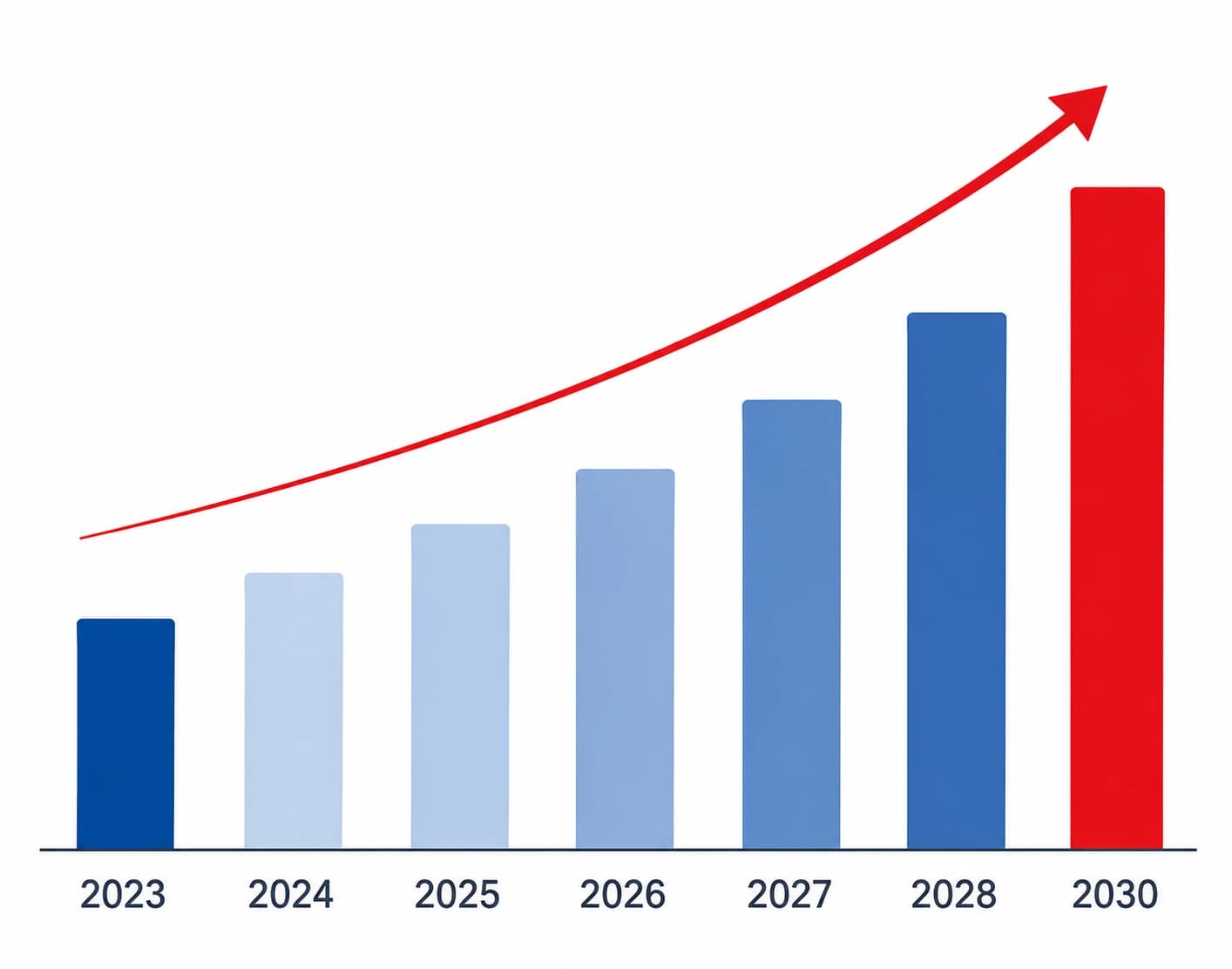
The global market for Robotic Learning Platforms was estimated to be worth US$ 180 million in 2025 and is projected to reach US$ 599 million, growing at a CAGR of 18.7% from 2026 to 2032.
Robotic learning platforms are software frameworks designed to facilitate the acquisition of autonomous skills, the training of intelligent behaviors, and the optimization of task-execution capabilities in robots. By integrating technical modules—such as multimodal data acquisition, robot demonstration (teaching), data cleaning and annotation, training dataset management, simulation environment construction, machine learning model training, policy evaluation, and model deployment—these platforms transform human operational experience, real-world robot interaction data, and virtual simulation data into intelligent behaviors that robots can learn and execute. Core technologies include imitation learning, reinforcement learning, behavior cloning, offline policy learning, diffusion policies, vision-language-action (VLA) models, robotic foundation models, and Sim-to-Real transfer. These platforms are capable of processing multimodal data—including camera imagery, depth information, joint positions, motion trajectories, force and tactile feedback, and natural language instructions—while supporting tasks such as robot task definition, training process management, model version control, policy performance testing, and continuous post-deployment optimization.
Robotic Learning Platforms cover data acquisition, dataset management, model training, evaluation, and robotic skill development
Imitation learning, reinforcement learning, and hybrid learning constitute the three principal learning approaches
Simulation-based, real-world, and hybrid environments form the core training environment segments
Humanoid robots, industrial robotic arms, dexterous hands, and warehouse robots represent major application categories
Integration of robotic data infrastructure, learning algorithms, and simulation environments is a central platform capability
Robotic Learning Platforms are evolving from fragmented data-processing and model-training tools into integrated development environments connecting data collection, dataset management, simulation, policy training, evaluation, and deployment. Imitation learning remains important for converting human demonstrations into executable robot skills, while reinforcement learning supports iterative policy improvement through simulated and physical interactions. Hybrid learning approaches are gaining relevance as developers combine demonstration datasets, simulation-generated experiences, and real-world feedback. Another important development is the increasing use of standardized robotic datasets, reusable training pipelines, and foundation-model-compatible architectures. These developments are expanding platform requirements from individual algorithm development toward repeatable, scalable, and transferable robotic learning workflows.
The growing commercialization of humanoid robots, industrial manipulators, dexterous hands, and warehouse robots is increasing demand for scalable robotic intelligence development. Traditional robot programming often requires task-specific engineering and manual adjustment, creating demand for platforms that can learn behaviors from demonstrations and interaction data. Advances in machine learning, GPU computing, simulation technology, and multimodal AI are improving the feasibility of training more complex robotic policies. The expansion of embodied AI research and industrial automation investment is further supporting demand for integrated data acquisition, training, and evaluation infrastructure.
High-quality robotic data remains expensive and difficult to collect because demonstrations require physical hardware, skilled operators, sensor calibration, and consistent task execution. Differences in robot structures, degrees of freedom, sensors, control interfaces, and operating environments also create dataset fragmentation and reduce cross-platform reusability. Training complex policies requires substantial computing resources, while real-world validation can involve lengthy testing cycles and operational risks. For smaller robotics developers, the combined costs of hardware, data preparation, simulation infrastructure, and model training can create significant barriers to adoption.
The increasing demand for general-purpose robotic capabilities creates opportunities for platforms that integrate large-scale data management, simulation-based training, real-world demonstrations, and reusable pretrained policies. Humanoid robotics and dexterous manipulation offer particularly important development opportunities because their complex movements and interactions require extensive training data and iterative learning. Shared robotic datasets, standardized interfaces, cloud-based training services, and cross-robot learning frameworks could reduce development costs and accelerate technology commercialization. There is also potential for platform providers to develop specialized solutions for industrial manipulation, warehouse automation, and multi-robot collaboration.
A major challenge is transferring learned skills across different robot embodiments, hardware configurations, and operating environments while maintaining reliable performance. Differences between simulation and physical environments, inconsistent data quality, and limited representation of unusual operating conditions can affect model generalization. Platform providers must also address data ownership, dataset licensing, privacy, cybersecurity, and interoperability. As foundation models and learning algorithms develop rapidly, maintaining compatibility and delivering measurable improvements in real-world task performance will remain important commercial challenges.
The value chain of Robotic Learning Platforms begins with upstream data generation and infrastructure, including robotic hardware, cameras, force and tactile sensors, motion-capture systems, teleoperation interfaces, GPU computing, simulation engines, and data storage infrastructure. These components provide the physical and computational foundation for collecting robot demonstrations, generating synthetic experiences, and processing multimodal datasets. Midstream platform providers integrate data ingestion, annotation, dataset organization, learning algorithm interfaces, simulation environments, model training, evaluation, and deployment management. Value creation primarily comes from improving data usability, reducing repetitive engineering work, increasing training efficiency, and enabling the reuse of learned policies across tasks and robotic systems.
Downstream users include humanoid robot developers, industrial automation companies, robotic arm manufacturers, dexterous hand developers, warehouse automation providers, and research institutions. Revenue models may include software licensing, cloud computing and training subscriptions, enterprise platform services, data processing, and technical support. Major cost components include software research and development, computing infrastructure, data collection and annotation, simulation environment development, and customer-specific integration. Platforms that combine standardized data infrastructure, scalable training capabilities, and broad robot compatibility can potentially capture greater value across the robotic development lifecycle.
By Product Type, Robotic Learning Platforms are divided into Data Acquisition and Management and Learning and Training. Data Acquisition and Management platforms provide the infrastructure for collecting, annotating, cleaning, organizing, storing, and sharing robotic datasets. Their value is closely related to data quality, multimodal synchronization, labeling efficiency, dataset standardization, and compatibility with different robot configurations. Learning and Training platforms focus on model development, policy optimization, simulation-based learning, performance evaluation, and deployment preparation. These platforms provide the algorithmic capabilities that convert collected data and simulated experiences into executable robotic skills.
By Learning Method, the market covers Imitation Learning, Reinforcement Learning, and Hybrid Learning. Imitation learning uses human demonstrations or expert trajectories to teach robots specific tasks, making it relevant to manipulation and dexterous operations. Reinforcement learning optimizes robot behavior through repeated interaction and reward-based feedback, particularly in complex control and adaptive tasks. Hybrid learning combines demonstrations, simulation, and interaction-based optimization to improve training efficiency and policy robustness. By Training Environment, the market includes Simulation-Based Training, Real-World Training, and Hybrid Simulation and Real-World Training. Hybrid training provides an important technical pathway for combining scalable simulated experiences with physical validation and feedback.
Downstream Market Opportunities
Humanoid robots represent a significant application opportunity because their multi-joint structures, whole-body coordination, and complex interactions require extensive demonstrations and sophisticated learning workflows. Industrial robotic arms offer demand for repeatable manipulation, assembly, material handling, and adaptive operations in manufacturing environments. Dexterous hands create specialized requirements for fine-grained tactile feedback, object manipulation, grasping, and hand-eye coordination. Warehouse robots require learning capabilities for dynamic navigation, picking, sorting, and interaction with changing inventory environments. Across these applications, demand is increasingly associated with reusable robotic skills, multi-task learning, and the ability to deploy trained models across different hardware configurations.
Regional demand for Robotic Learning Platforms is influenced by robotics manufacturing concentration, AI computing infrastructure, research investment, availability of robotic datasets, and the maturity of industrial automation ecosystems. North America benefits from an established AI software and computing ecosystem, advanced robotics research, and the presence of major platform and foundation-model developers. China has strong potential supported by its industrial robot supply chain, humanoid robotics development, manufacturing applications, and expanding embodied AI ecosystem. Japan and South Korea have established robotics and automation industries, creating demand for learning platforms applicable to industrial manipulation, precision operations, and service robotics.
Europe also provides opportunities through its industrial robotics base, automation engineering capabilities, and robotics research institutions. Regional differences are reflected in the balance between research-oriented platform development, industrial deployment, and hardware ecosystem integration. Markets with strong robot manufacturing and application bases have opportunities to develop locally adapted datasets and learning workflows, while regions with mature cloud and AI infrastructure can support scalable training services and cross-border collaboration. Regional market shares and growth rankings require corresponding regional revenue measurements and are not quantified in this summary.
Competitive Landscape Analysis
The competitive landscape of Robotic Learning Platforms spans AI computing and simulation infrastructure providers, open-source robotics software ecosystems, specialized learning platform developers, robotic hardware companies, and data infrastructure providers. NVIDIA Corporation has a broad development ecosystem through Isaac Lab, which supports reinforcement learning, imitation learning, simulation, and policy evaluation, while its broader Isaac platform connects simulation, AI models, and robot development workflows. Hugging Face, Inc. contributes through LeRobot, which connects real-robot control, demonstration recording, standardized datasets, imitation-learning policies, and deployment workflows. Other specialized participants, including Neuracore, Lightwheel, and Noematrix, are positioned around robotic data, simulation, and learning infrastructure. ROBOTIS Co., Ltd. contributes from the robotics hardware and software ecosystem, while Intrinsic Innovation LLC and Google LLC are associated with broader robotics software and AI development capabilities. Scale AI, Inc. and Encord participate in the data infrastructure ecosystem through data management and annotation capabilities. participants Chinese, including Shanghai Qionche Intelligent Technology Co., Ltd., Aio Intelligent (Shenzhen) Co., Ltd., Shenzhen Zhenjue Wanxiang Technology Co., Ltd., People's Data Management (Beijing) Co., Ltd. and Beijing Humanoid Robot Innovation Center Co., Ltd., contribute to the domestic robotics data and embodied intelligence ecosystem. Competitive differentiation increasingly depends on dataset quality, data standardization, simulation fidelity, training efficiency, algorithm compatibility, robot hardware coverage, and the ability to translate trained policies into reliable real-world performance.
This report provides a comprehensive view of the global market for Robotic Learning Platforms, covering total sales revenue, the market share and ranking of key companies, along with analyses by region & country, by Type, and by Application.
The Robotic Learning Platforms market size, estimations, and forecasts are presented in terms of sales revenue ($ millions), with 2025 as the base year and historical and forecast data from 2021 to 2032. The report combines quantitative and qualitative analysis to help readers develop growth strategies, assess the competitive landscape, evaluate their position in the current marketplace, and make informed business decisions regarding Robotic Learning Platforms.
Chapter 1: Introduces the scope of the report and the global market size (value). It also summarizes market dynamics and recent developments; identifies key drivers and restraints; outlines challenges and risks for players; reviews relevant industry policies.
Chapter 2: Provides a detailed analysis of the Robotic Learning Platforms companies' competitive landscape—including revenue shares, recent development plans, and mergers and acquisitions (M&A).
Chapter 3: Analyzes market segmentation by Type, presenting the size and growth potential of each segment to help readers identify blue-ocean opportunities.
Chapter 4: Analyzes market segmentation by Application, presenting the size and growth potential of each downstream segment to help readers identify blue-ocean opportunities.
Chapter 5: Presents Robotic Learning Platforms revenue at the regional level. It offers a quantitative assessment of market size and growth potential by region and summarizes market development, future prospects, addressable space, and country-level market size worldwide.
Chapter 6: Presents Robotic Learning Platforms revenue at the country level. It provides segmented data by Type and by Application for each country/region.
Chapter 7: Profiles key players, detailing the main companies' product revenue, gross margin, product portfolios, recent developments, etc.
Chapter 8: Analysis of Value Chain, including the upstream and downstream of the industry.
- ★ What Is The Overall Market Size And Projected Growth Rate Across Global And Regional Segments?
- ★ How Does The Market Size And Growth Outlook Vary Across Major Countries?
- ★ Which Region Or Market Sub-Segment Is Anticipated To Dominate Growth During The Forecast Period?
- ★ What Are The Primary Factors Expected To Drive Market Expansion, And What Challenges May Restrain Growth?
- ★ Which Emerging Technologies And Market Trends Are Shaping The Future Landscape?
- ★ What Are The Most Significant Opportunities Available In The Market?
- ★ Who Are The Leading Manufacturers Actively Participating In The Global Market?
- ★ Which Company Currently Holds The Largest Share Of The Market?
- ★ What Are The Potential Growth Avenues For New Entrants In The Global Market?