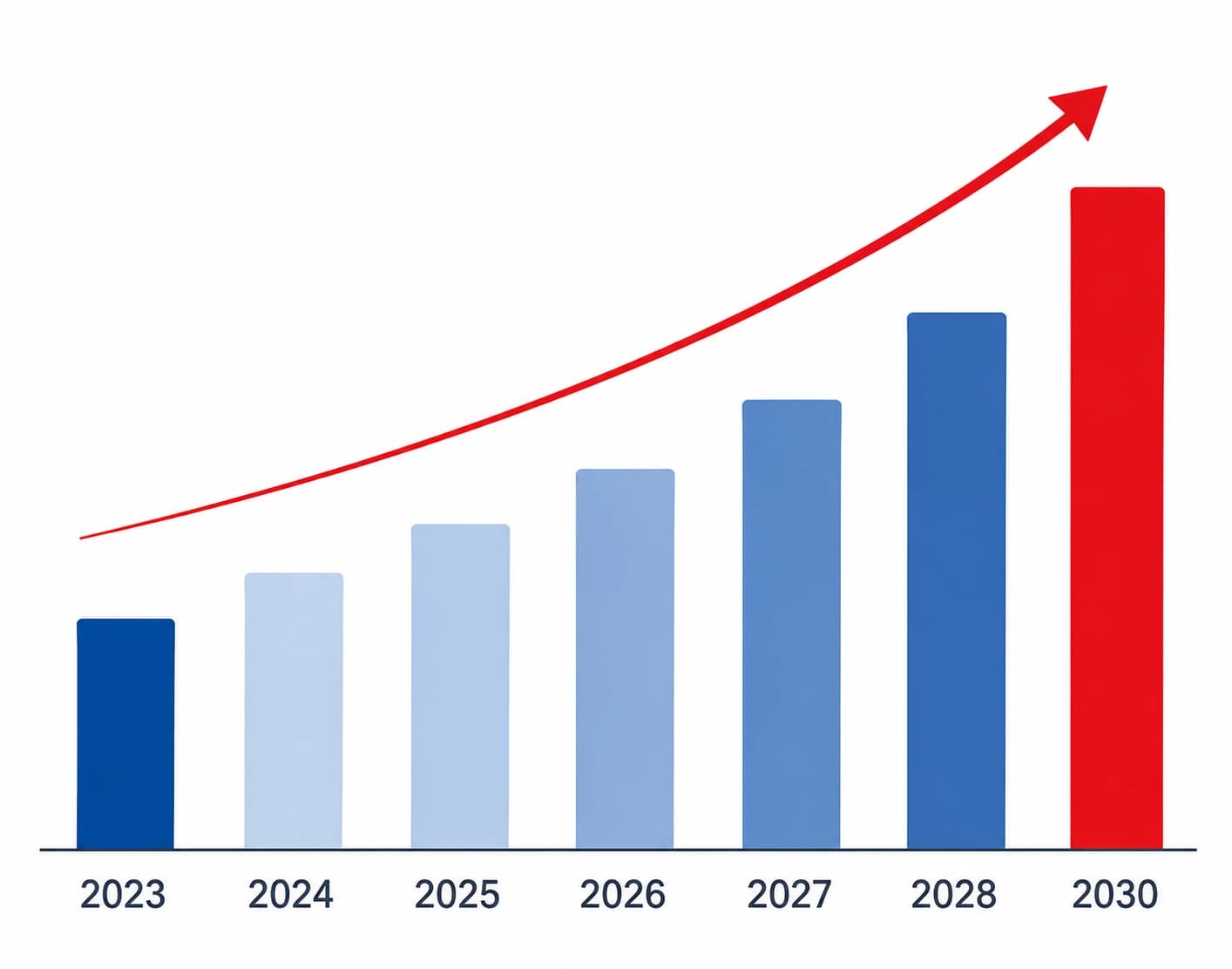
The global Quantum Photonic Integrated Circuit Chip market was valued at US$ 119 million in 2025 and is anticipated to reach US$ 874 million by 2032, witnessing a CAGR of 31.2% during the forecast period 2026-2032.
A Quantum Photonic Integrated Circuit Chip refers to a specialized photonic integrated chip, packaged chip or chip-level module that uses photons as quantum information carriers and integrates quantum optical functions such as photon generation, modulation, interference, routing, delay, detection, quantum-state preparation, quantum-state measurement, quantum random number generation and quantum optical interfacing onto a compact semiconductor or hybrid photonic platform. The core technology platforms include silicon photonics, silicon nitride, thin-film lithium niobate, indium phosphide, quantum-dot single-photon sources, integrated waveguides, phase shifters, beam splitters platforms include silicon photonics, silicon nitride, thin-film lithium niobate,, interferometric meshes, on-chip detectors and hybrid photonic packaging.
This study focuses on chips and chip-level modules used in photonic quantum computing, quantum key distribution, quantum random number generation, quantum-secure communications, quantum networking, quantum sensing and research-grade quantum optical systems.
Indicative pricing varies significantly by product maturity and configuration: standard QRNG chips or compact security modules may range from hundreds to several thousand U.S. dollars; research-grade single-photon source chips, chip-scale QKD modules and programmable quantum photonic processors may range from tens of thousands to several hundred thousand U.S. dollars; customized photonic QPUs, quantum photonic chipsets and dedicated tape-out or packaging services are usually priced on a project, wafer, system or strategic collaboration basis.
Based on our research, the Quantum Photonic Integrated Circuit Chip market should not be treated as a generic sub-segment of the broader photonic integrated circuit industry. Its industrial essence lies in converting quantum optical experiments from bulky, alignment-sensitive and laboratory-based optical benches into compact, packaged and manufacturable chip-level hardware. Compared with classical silicon photonics for data communications or AI optical interconnects, quantum photonic integrated chips require far more stringent performance metrics, including single-photon quality, quantum-state fidelity, optical loss, phase stability, interference accuracy, noise suppression and system-level scalability. Therefore, the appropriate reporting scope should focus on quantum-application-specific photonic chips and chip-level modules, rather than all silicon photonic or integrated photonic devices.
From a supply-side perspective, the global industry is structured around four layers: full-stack photonic quantum computing companies, quantum security chip and module suppliers, specialized photonic foundry platforms, and emerging quantum networking chip developers. PsiQuantum, Xanadu, Quandela, QuiX Quantum, ORCA Computing, TuringQ and QBoson are more closely associated with photonic QPU or photonic quantum computer architectures. ID Quantique, KETS, Quside, Quantum Dice and KEEQuant are more focused on QRNG, QKD and quantum-secure communication use cases. LIGENTEC, GlobalFoundries, imec, SMART Photonics and New Origin provide the process, prototyping and manufacturing infrastructure required for scaling quantum photonic hardware. Because revenue is often recognized through systems, projects, government contracts or cloud access, chip-level revenue must be estimated conservatively and separated from broader system-level value.
From a demand-side perspective, the clearest near-term commercial opportunities are in quantum random number generation, quantum-secure communications, research-grade quantum optical platforms and early photonic quantum processor systems. Longer-term demand is expected to come from fault-tolerant quantum computing, quantum networking, quantum data-center infrastructure and national quantum technology programs. Policy and funding momentum in the United States, Europe and China is supporting the transition from laboratory demonstrations to manufacturable quantum photonic devices. Nevertheless, the market remains constrained by fabrication yield, low-loss integration, photonic packaging, cryogenic or temperature-stable operation, electronic control integration and the lack of large-scale end-user application validation.
From a technology-route perspective, silicon photonics and silicon nitride platforms offer advantages in manufacturability, wafer-scale processing, low-loss waveguides and compatibility with existing semiconductor infrastructure. Thin-film lithium niobate is strategically relevant for high-speed modulation and nonlinear photonic functions, while quantum-dot single-photon sources, on-chip detectors and heterogeneous integration are critical to the scalability of photonic quantum processors. Future competition will not be determined by a single chip metric alone. It will depend on the ability to combine chip design, fabrication, packaging, testing, control electronics, software stack, application ecosystem and capital-intensive manufacturing scale-up.
Overall, the industry is still in an emerging growth phase. It offers high medium-term growth potential, but it also faces meaningful technology-route uncertainty. Superconducting, trapped-ion, neutral-atom and semiconductor-spin quantum computing platforms remain strong alternative routes. Photonic quantum chips are most likely to generate clearer revenue first in QRNG, chip-scale QKD, deterministic single-photon sources, quantum networking interfaces and research-grade photonic processors, before expanding into larger-scale photonic QPUs and quantum data-center infrastructure.
This report aims to provide a comprehensive presentation of the global market for Quantum Photonic Integrated Circuit Chip, with both quantitative and qualitative analysis, to help readers develop business/growth strategies, assess the market competitive situation, analyze their position in the current marketplace, and make informed business decisions regarding Quantum Photonic Integrated Circuit Chip.
The Quantum Photonic Integrated Circuit Chip market size, estimations, and forecasts are provided in terms of revenue ($ millions), considering 2025 as the base year, with history and forecast data for the period from 2021 to 2032. This report segments the global Quantum Photonic Integrated Circuit Chip market comprehensively. Regional market sizes, concerning products by Product Function, by Application, and by players, are also provided.
For a more in-depth understanding of the market, the report provides profiles of the competitive landscape, key competitors, and their respective market ranks. The report also discusses technological trends and new product developments.
The report will help the Quantum Photonic Integrated Circuit Chip manufacturers, new entrants, and industry chain related companies in this market with information on the revenues for the overall market and the sub-segments across the different segments, by company, by Product Function, by Application, and by regions.
Chapter 1: Introduces the report scope of the report, executive summary of different market segments (by region, product type, application, etc), including the market size of each market segment, future development potential, and so on. It offers a high-level view of the current state of the market and its likely evolution in the short to mid-term, and long term.
Chapter 2: key insights, key emerging trends, etc.
Chapter 3: Manufacturers competitive analysis, detailed analysis of Quantum Photonic Integrated Circuit Chip manufacturers competitive landscape, revenue market share, latest development plan, merger, and acquisition information, etc.
Chapter 4: Provides profiles of key players, introducing the basic situation of the main companies in the market in detail, including product revenue, gross margin, product introduction, recent development, etc.
Chapter 5 & 6: Revenue of Quantum Photonic Integrated Circuit Chip in regional level and country level. It provides a quantitative analysis of the market size and development potential of each region and its main countries and introduces the market development, future development prospects, market space, and market size of each country in the world.
Chapter 7: Provides the analysis of various market segments by Product Function, covering the market size and development potential of each market segment, to help readers find the blue ocean market in different market segments.
Chapter 8: Provides the analysis of various market segments by Application, covering the market size and development potential of each market segment, to help readers find the blue ocean market in different downstream markets.
Chapter 9: Analysis of industrial chain, including the upstream and downstream of the industry.
Chapter 10: The main points and conclusions of the report.
- ★ What Is The Overall Market Size And Projected Growth Rate Across Global And Regional Segments?
- ★ How Does The Market Size And Growth Outlook Vary Across Major Countries?
- ★ Which Region Or Market Sub-Segment Is Anticipated To Dominate Growth During The Forecast Period?
- ★ What Are The Primary Factors Expected To Drive Market Expansion, And What Challenges May Restrain Growth?
- ★ Which Emerging Technologies And Market Trends Are Shaping The Future Landscape?
- ★ What Are The Most Significant Opportunities Available In The Market?
- ★ Who Are The Leading Manufacturers Actively Participating In The Global Market?
- ★ Which Company Currently Holds The Largest Share Of The Market?
- ★ What Are The Potential Growth Avenues For New Entrants In The Global Market?